
That page is medical copywriting at work. It persuades like any other copy, but it has to stay accurate and inside the rules while it does. Regular copywriting gets a lot more room to swing.
Over the years I've spent writing for clinics, I've watched strong general copywriters stumble here. They can write just fine. The trouble is that a line built to sell sneakers can mislead a scared reader, and in healthcare that mistake costs more than a sale.
Most clinic pages I audit fail the same test. They read well in a meeting and badly at midnight. Almost every one of the medical copywriting tips I give clinics traces back to that gap, which is why effective medical healthcare copywriting services focus on how patients actually read and understand information.
TL;DR Quick Answers
Medical Copywriting Tips
The best medical copywriting tips start with one rule: write for the worried reader first, and the sale gets easier. These are the habits I use most with clinics:
Lead with the patient's question. "Is this serious?" beats "Serving the community since 2009."
Translate the jargon. "Epidermis" becomes "the top layer of skin."
Name a source for every number. "(CDC)" earns trust, and "studies show" doesn't.
Claim only what evidence supports. The FTC expects competent and reliable scientific evidence behind health claims.
Get written permission before you share a patient's story. HIPAA generally requires it.
Read the page out loud before it goes live. If you stumble, a scared reader will too.
Top Takeaways
Same craft, shorter leash. Both kinds of copy persuade, but medical copy has to do it without bending a fact.
Answer the worried question first. "Is this serious?" comes before your credentials.
Name your source. "(CDC)" carries weight that "studies show" never will.
Know which rules apply. The FTC covers your claims, and HIPAA covers your patient stories.
Trade superlatives for specifics. "Most first-degree burns heal in about a week" will outsell "guaranteed results."
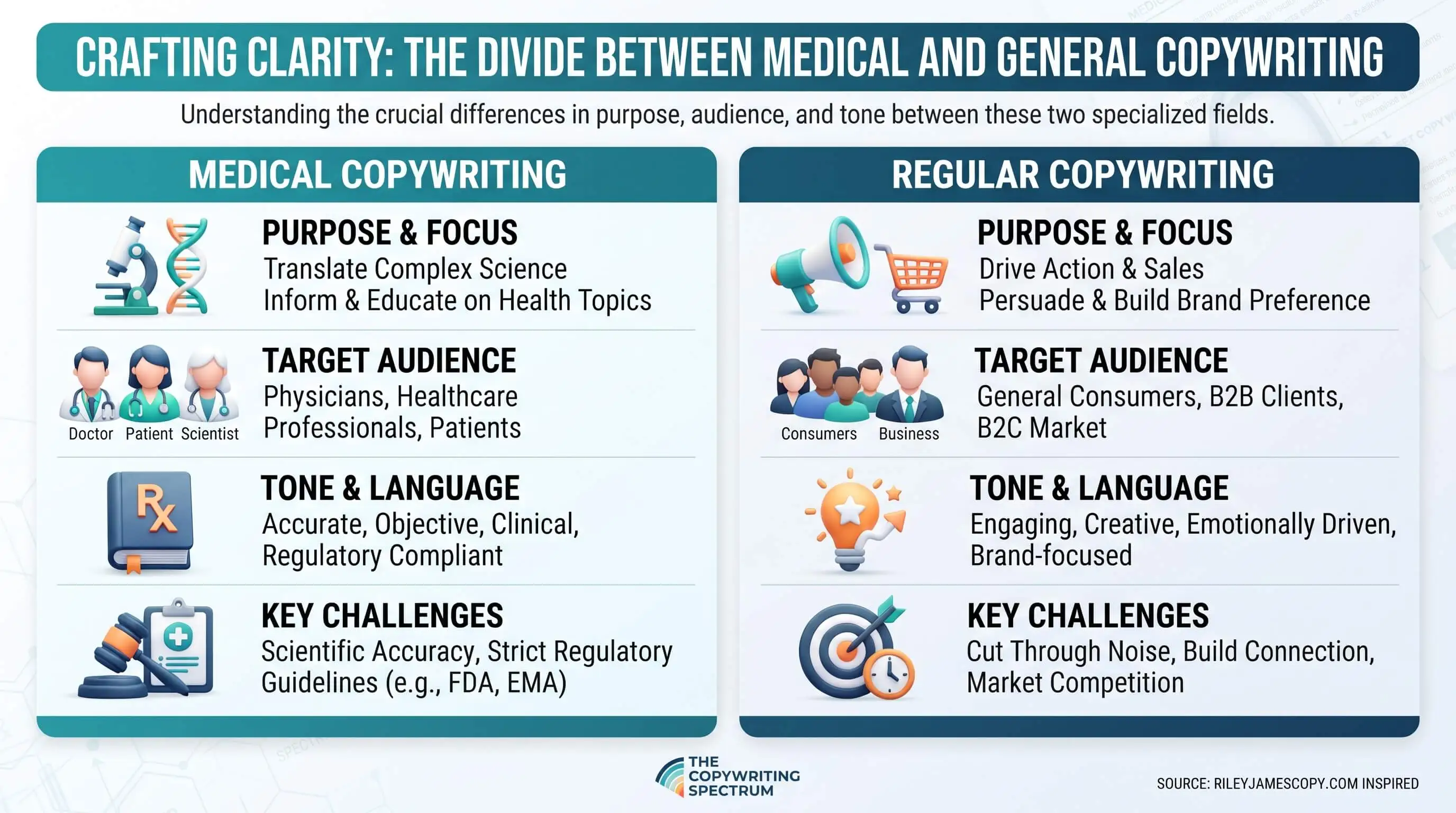
Medical Copywriting vs Regular Copywriting at a Glance
Both crafts exist to get a reader to act. Wikipedia describes copywriting as persuasive writing for advertising and marketing, aimed at selling a product or service. General copywriters are very good at that. They write the hook you remember and the headline you can't help clicking.
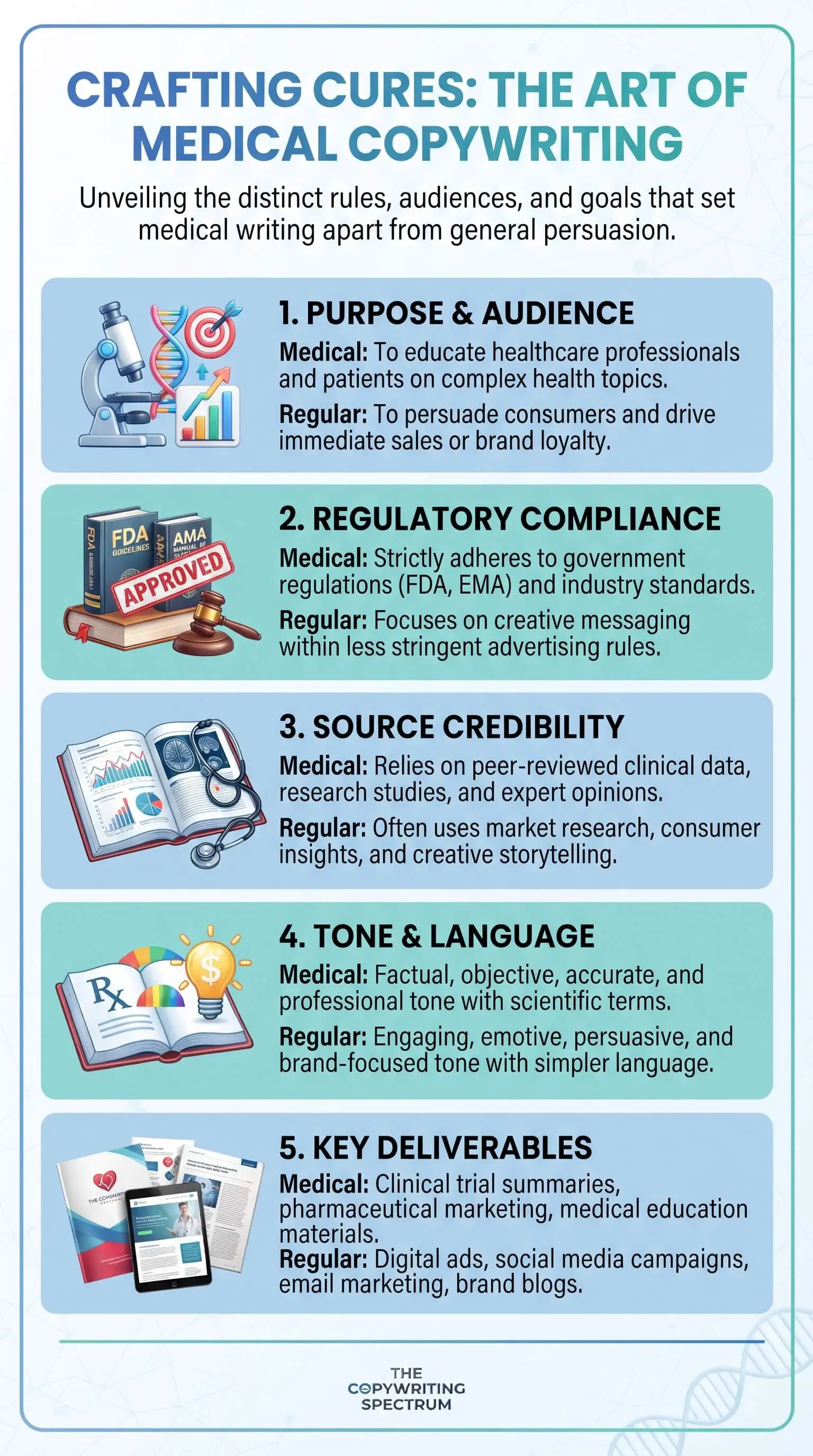
Medical copy keeps every one of those tools. It just uses them with far less room for error, and here's where the two part ways:
The reader: A regular ad usually reaches someone browsing. Medical copy often reaches someone worried, sore, or searching for symptoms at 11 p.m.
The goal: Both want the click. Medical copy has to earn it without bending a single fact.
Claims: "Best in town" works fine for a pizza shop. In healthcare, you say only what the evidence supports.
Proof: Reviews carry most regular copies. Medical copy leans on named clinical or government sources, and any patient story needs written permission first.
Language: Clever wordplay is a bonus in most industries. Here, plain words a nervous reader can follow on the first pass do far more work.
Rules: General advertising law covers both. Medical copy adds HIPAA, the FTC's health-claim standard, and FDA rules for drugs and devices.
Cost of a mistake: A sloppy sneaker ad loses a sale. A sloppy burn-care page can keep someone home who should be getting care.
Four Differences That Shape Every Line of Medical Copy
The Reader Arrives Worried, Not Curious
Someone shopping for running shoes is in a decent mood. Someone staring at a blister on their forearm isn't. They're scanning for one answer, which is whether this is serious, and good medical copy gives it to them up top, the way How to Identify a Second-Degree Burn starts with what the reader is actually looking at.
Accuracy Outranks Cleverness
A clever line that a frightened reader misreads has failed, however good it sounded in the meeting. The CDC notes that even people who read well struggle with health information when they're scared or the terms are new to them. So when I edit, the wordplay goes before the facts do.
Blurry copy has a cost, too. When a page muddies the line between "treat this at home" and "get help now," people wait longer than they should. That's exactly why pages like When Is a Burn Considered a Medical Emergency? exist.
Every Claim Needs Proof You Can Name
Regular copy can call itself "the best" and nobody blinks, but health copy doesn't get that pass. The FTC's guidance says health claims need competent and reliable scientific evidence behind them, and that covers what an ad implies as well as what it says outright. So "guaranteed results" and "scar-free" are off the table before the first draft starts.
Patient Stories Come With Rules
In most industries, a glowing customer story is free marketing. Healthcare plays by different rules. Under HIPAA, a clinic generally needs a patient's written authorization before using their protected health information in marketing. Get the signature, then write the story.
Same Message, Two Ways: A Burn Care Rewrite
Here's one line for a wound care clinic, written both ways.
Regular copy: "Burned? Our breakthrough treatment guarantees fast, scar-free healing. Book today!"
Medical copy: "Most first-degree burns heal on their own in about a week. If yours is blistering, bigger than about three inches across, or on your face or hands, we can see you today and walk you through what to expect." [VERIFY: healing time and size threshold need clinician sign-off]
In my experience, the second version promises less and books more appointments. It tells the reader where they stand, gives them a timeline they can check against The Healing Process of First-Degree Burns, and gives them a clear reason to call. Believable beats breathless.
Medical Copywriting Tips for Clinics and Wound Care Brands
These are the habits I lean on with almost every clinic, roughly in the order I apply them:
Lead with the patient's question, not your credentials. "Is this burn serious?" earns more attention than "Serving the community since 2009."
Translate the jargon. "Epidermis" becomes "the top layer of skin," and "partial-thickness burn" becomes "a burn that blisters."
Name the source behind every number. "(CDC)" carries weight. "Studies show" doesn't.
Match the reader's stage. Someone researching symptoms needs education. Someone already on your booking page needs fewer steps, not more persuasion.
Read it out loud. If you stumble, your reader will too, so keep cutting until you don't.
If you want the longer version, including the mistakes I see sink clinic marketing most often, I wrote up my full set of medical copywriting tips with examples for each one.
Do You Need a Medical Copywriter or a Regular One?
The short answer depends on what the copy says. If a page describes symptoms, treatment, or aftercare, or makes any health claim at all, you want someone who knows medical copy. Holiday hours or an office-move announcement? A good general copywriter can handle that just fine. And anything that quotes a patient goes to the medical side every time, because that's where HIPAA lives.
"Before I touched a new clinic's site, I read it out loud as if I'd just burned my hand on the stove. If I can't tell within two sentences whether to run it under cool water or get in the car, the copy isn't finished. Every copywriter asks whether a line will make someone want the thing. In healthcare, I ask a second question too: will this still be true for the person reading it at midnight, scared? Five-plus years in, I've noticed the clinics that answer that one honestly usually wins the first one as well."
Essential Resources
Seven sources I keep open when I'm writing healthcare copy. Skim the ones that match your moment.
1. Know the Craft Before You Specialize It
Wikipedia's overview runs from early print ads to the way web copy now overlaps with SEO. It's a quick refresher on the persuasion half of the job.
Source: Wikipedia: Copywriting
2. Picture the Reader Before You Write a Word
The CDC explains why even confident readers struggle with health information when they're scared or the terms are unfamiliar. Read it once, and you'll stop writing "partial-thickness" without a translation.
Source: CDC: Understanding Health Literacy
3. Turn Clinical Language Into Easy Reading
The National Library of Medicine walks you through planning, writing, and testing health materials, and it suggests aiming for about a 7th or 8th grade reading level. Short and practical.
Source: MedlinePlus: How to Write Easy-to-Read Health Materials
4. Borrow the Federal Plain Language Playbook
Digital.gov's guide series covers writing, design, and testing for understanding. Short sentences, active voice, and clear headings are the backbone of good medical copy, and this is where they're laid out best.
Source: Digital.gov: Plain Language Guide Series
5. Check Every Health Claim Against the FTC Standard
The FTC spells out what counts as a health claim, including the ones you only imply, and what evidence you need before making it. I treat it as an editing checklist.
Source: FTC: Health Products Compliance Guidance
6. Get Patient Stories Right Under HIPAA
HHS explains when marketing that uses protected health information needs a patient's written authorization and when it doesn't. Read it before you publish a single testimonial.
Source: HHS: HIPAA Privacy Rule and Marketing
7. Run the AMA's Gut Check on Physician Ads
The AMA's position is simple. Physicians can advertise, but the message can't be false, misleading, or set up expectations the care can't meet.
Source: AMA Code of Medical Ethics: Advertising & Publicity
These seven essential resources help a copywriter Spokane WA healthcare providers to create clear, accurate, and trustworthy medical content by applying health literacy principles, plain language guidelines, evidence-based claims, HIPAA requirements, and ethical healthcare advertising standards.
Supporting Statistics
These numbers explain why medical copy can't be written like an ad for sneakers.
1. 58.5% of U.S. adults went online for health or medical information in the past year.
The CDC's National Health Interview Survey found this during July to December 2022. In my experience, the page they land on often does the reassuring before any clinician gets the chance, so it had better be right.
Source: CDC/NCHS: Health Information Technology Use Among Adults, July–December 2022
2. Nearly half of American adults, about 90 million people, have trouble understanding and using health information.
The Institute of Medicine linked limited health literacy to more hospital stays and more emergency care. A clever line doesn't help anyone who can't follow it.
Source: National Academies: 90 Million Americans Are Burdened With Inadequate Health Literacy
3. About 36% of U.S. adults scored at Basic or Below Basic health literacy.
In that national assessment, 22% landed at Basic and 14% at Below Basic. So I write every patient-facing page for a smart, busy person who's seeing these terms for the first time.
Source: NCES: The Health Literacy of America's Adults
Final Thoughts and Opinion
People sometimes treat medical copywriting as regular copywriting with the edges sanded off. I see it the other way around. It's the same craft on a much shorter leash.
The tools don't change. You still need a hook, a benefit the reader actually cares about, and an obvious next step. What changes is the price of getting it wrong. A sneaker ad that overpromises loses a customer, while a burn-care page that overpromises can keep someone home when they should be getting help.
The clinics I've seen do this well share a handful of habits. They write to one worried person instead of "patients" in general. They name their sources out loud, which makes them sound more sure of themselves, not less. They've traded superlatives for specifics a reader can check. And they let a clinician read the page before it goes live.
Honestly, if your current copy reads beautifully but would make your compliance person wince, it isn't done yet. Fix the accuracy first. Persuasion gets a lot easier once the reader believes you.
Frequently Asked Questions
Q: What Is Medical Copywriting?
A: It's persuasive writing for healthcare brands, including clinic web pages, emails, ads, and patient education. The job is to get a reader to act while staying accurate and inside health marketing rules. I usually describe it as sales writing that has to survive a fact-check.
Q: How Is Medical Copywriting Different From Regular Copywriting?
A: Regular copy can lean on bold promises and clever wording. Medical copy writes for a worried reader, backs every claim with evidence, sticks to plain language, and follows HIPAA and the FTC's health-claim standard. The tools overlap almost completely. What's different is how little room you get for error.
Q: Is Medical Copywriting the Same as Medical Writing?
A: No. Medical writing produces technical documents for experts, like regulatory filings and journal articles. Medical copywriting creates marketing for patients and buyers. Both demand accuracy, but they speak to very different readers with very different goals.
Q: Do You Need a Medical Degree to Write a Medical Copy?
A: Not for most patient-facing marketing. Careful research, a knack for plain language, and the habit of checking every claim matter more. I'd still have a clinician read anything that describes symptoms, treatments, or outcomes before it goes live.
Q: What Are the Most Important Medical Copywriting Tips for a Small Practice?
A: Lead with the patient's question, translate jargon into everyday words, and cite a named source for every number. Match the message to where the reader is in their decision, then read the page out loud before you publish. Those five habits fix most of the clinic copy I see.
Want a Copy That's Clear Enough to Trust?
If your clinic's pages sound polished but still leave a worried reader guessing, that's fixable. Pick one page, hold it up against the comparison above, and see where it slips. When you'd like a second set of eyes, grab a free 15-minute call with Riley James Copy and we'll go through it together.


